 |
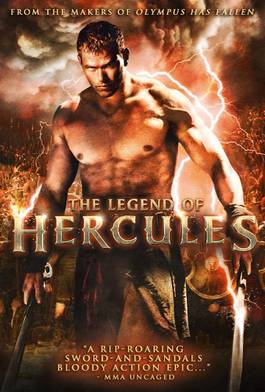
| The Legend of Hercules 2014 Renny Harlin (1) |
Like many adaptations of Greek mythology in modern media, The Legends of Hercules, has loose similarities to the actual myth. The film uses a few similar core characters, changes the use of certain elements of the 12 labors, as well as changes fundamental aspects of Hercules's Greek mythology to appeal to contemporary values and morals. (4)
See here for a better understanding of Hercules's original Greek Mythology: Link (7).
 |
| Youthful Hercules, 69-96 CE, The Metropolitan Museum, New York, NY, USA (3) |
Representation
Similar to the Greek myth of Hercules, in the film Hercules is the son of Zeus and Alcmene, with his mortal ‘father’ being Amphitryon. But this is largely where the similarities stop. In, The Legends of Hercules, Hebe is depicted as Hercules' solo love interest; and while some myths back this up, it is only after Hercules has been granted immortality that he pursues Hebe as a lover.(5) In the movie, Hercules is also depicted as having a brother who tries to overtake his role in the family throne rather than a cousin. This is how his story is depicted in original materials. (4,7)
Unlike the well-known myths of Hercules, Hera is not at all mentioned, so Hercules isn’t granted his infamous 12 labors.(7) However, some elements of the original tasks are still depicted within the movie in different manners. The film focuses on Hercules being captured in battle and fighting to get free, to make it back to his lover, Hebe before she can be married off to his brother.(4) The movie morphs some of the 12 labors into other action sequences revolving around Hercules and his attempt to survive and escape his capture and return to agores.(4) One element of the labors is used to depict Hercules’ strength at the very beginning of the film; Hercules defeats a lion that attacks him and his brother(4) (Slaying of the Nemean Lion)(6). After Hercules kills the lion, his brother takes it's skin and claims that he is the one who defeated the lion, and gloats with it in front of their family and peers, Hercules doesn't try and correct his brother's version of the event.(4)
 |
| Hebe, The Legends of Hercules (2) |
Contemporary Perspectives
In the film The Legends of Hercules, the presence of women within the story are independent from the men around them. Instead of being like Hera and plotting strategic ways to get revenge against her husband, Alcmene focuses on doing what she wishes - providing love and protection for her child, Hercules.(4) Her desire is to be a loving mother, not necessarily a wife to be kept. Hercules’ love interest in the movie, Hebe, takes a similar feminist stance. Hebe uses her voice to speak for herself and her wishes. While she may not be able to change her outcome, she still stands her ground against the male characters in the film. She made plans with her true love, Hercules to elope and run away with him, while traditionally, women in these stories are betrothed against their will to gods or other men in power.(4) The film characterizes Hebe and Alcmene as independent from their husbands and their fates, giving them each a voice and allowing them to share their desires with the other characters.
In Greek mythology, women are secondary characters to their sons and husbands, or they fill in roles of lovers, mothers, Goddesses, caretakers, etc. They do not have a sense of self-use, the reader frequently sees them treated as property rather than people. In the film, Hercules' mother Alcmene hid her secret of Hercules being Zeus’ son to protect Hercules from her husband.(4) Alcmene made her own decisions, she prayed to Zeus and Athena, without needing to obtain her husband's permission, and purposefully hiding it from him.(4) She lived a life outside of her husband, though it's not fully depicted in the movie, it is known through her actions. This differs greatly from original Greek mythology. Though there are women who live without their husbands for a time within some myths, like Penelope living by herself while Odysseus is gone, the woman’s actions are exclusively derived from a need to appease their husband when they return. Hera, who lived a very separate life from Zeus, is predominantly featured in stories where her actions are in spite of her husband. These are examples that show, that typically in Greek stories, the woman’s life focuses on a man, even in their (the women) independence.
 |
| Hercules, The Legends of Hercules (2) |
What does the adaptation add to representation?
Work Cited
Schaefer, Sandy. “The Legend of Hercules.” ScreenRant, 10 Jan. 2014, https://screenrant.com/db/movie/the-legend-of-hercules/. Accessed 27 Mar. 2025.
“The Legend of Hercules (2014).” IMDb, 2025, https://www.imdb.com/title/tt1043726/mediaviewer/rm2305871872/. Accessed 27 Mar. 2025.
Patel, Ameera. “How to Show up in a Gym – 3 Ancient Sculptures of Hercules.” DailyArt Magazine, 20 Aug. 2022, https://www.dailyartmagazine.com/sculptures-of-hercules/.
The Legend of Hercules. Directed by Renny Harlin, performances by Kellan Lutz, Gaia Weiss, and Scott Adkins, Summit Entertainment, 2014.
“Greek Mythological Story of Hebe and Hercules.” https://www.greekboston.com, 5 Jan. 2017, www.greekboston.com/culture/mythology/hebe-hercules/.
Madeleine. “What Were the 12 Labors of Hercules? -.” Theoi.com, 13 Sept. 2019, https://www.theoi.com/articles/what-were-the-12-labors-of-hercules/.
History.com Editors. “Hercules: Myth, Legend, Death & 12 Labors | HISTORY.” HISTORY, 7 Feb. 2011, https://www.history.com/articles/hercules.


Hey, I loved your blog and the fact that women are portrayed as independent from the men around them does make me want to watch the movie. I love what you said about Alcmene that she has a “desire to be a loving mother, not necessarily a wife to be kept.” Just the way you phrased that sentence is so good! I feel like the way you formatted you blog was good, and you definitely made The Legends of Hercules seem like it is a good film. The last paragraph is a good ending to your blog.
ReplyDeleteI think your take on the movie is really important especially for women! Great job! It was well described and you put a lot of thought into it.
ReplyDelete